

Äpplet
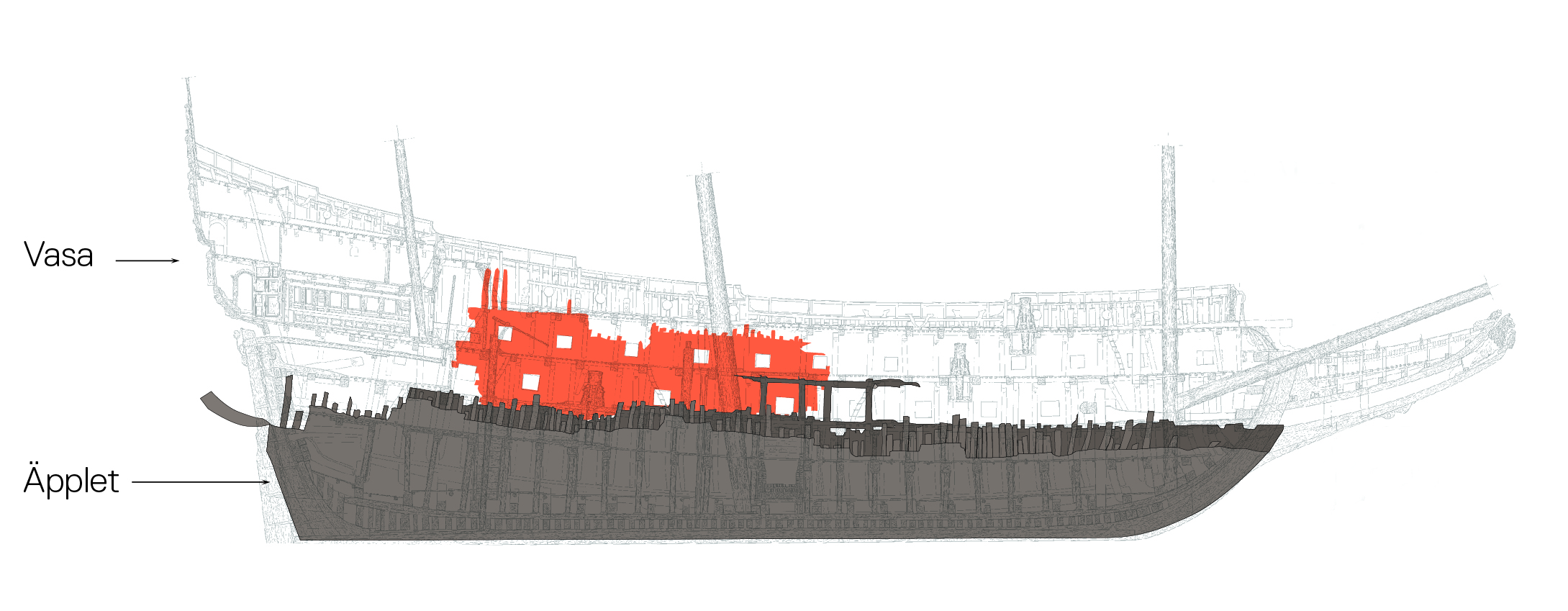
When king Gustav II Adolf ordered ships for his fleet one of them sank and became world famous: Vasa. But the ship has a sister: Äpplet.
As early as the mid-1500s, the Swedish navy began work on blocking a narrow strait off Vaxholm. During the 1600s, at least ten large Swedish warships were deliberately sunk on the site. One of them was Äpplet.
Äpplet was completed in 1629 by the shipbuilder Hein Jacobsson. He had completed Vasa the year before and suspected, even before the ship was launched, that Vasa had been built too narrow and was therefore likely to be unstable. So Äpplet was built wider, with a slightly different hull shape.
When Sweden joined the Thirty Years' War, Äpplet was among the ships sailing towards Germany. She had about 1,000 men on board, of which 900 were soldiers. Following the war, the ship was in active service until 1658. She was probably idle most of the time – larger ships were rarely used because they were expensive to maintain, inferior as sailing vessels and more difficult to manoeuver than smaller ships.
Äpplet was inspected in 1658 and deemed to be no longer in such condition that it would be worth repairing. The following year, she was sunk.
In 2021, together with the Swedish navy, the museum’s maritime archaeologists found a huge shipwreck in a strait outside Vaxholm, and investigations continued into the spring of 2022. Most of the hull is preserved up to the height of the lower battery deck and protrudes about 6-7 metres from the bottom of the sea. Parts of the ship's sides have fallen to the bottom but are relatively intact.
After compiling data on the ship's dimensions, construction details, wood samples and archival material, the museum’s archaeologists were able to establish that the wreck they had discovered was indeed Äpplet, Vasa's sister ship.
The oak for the ship’s timber was felled in 1627 in the Mälardalen area, east of Stockholm – in the same place as Vasa's timber just a few years earlier
Facts
Deep
Build
1629
Length
47,7 metres
Width
12,6 metres
Shipwreck
1659
Ship type
Örlogsfartyg